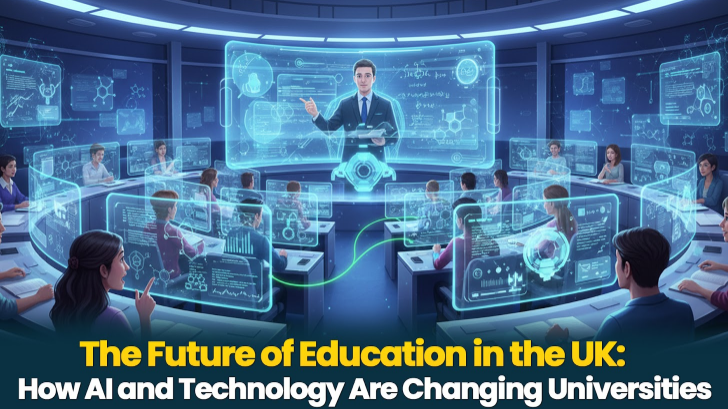
The United Kingdom has traditionally been a leader in the international education system, including some of the most reputable universities worldwide. This legacy is being applied today by innovation that is facilitated by Artificial Intelligence (AI) and data analytics and digital learning platforms. Technology is transforming the way students are learning, teachers are teaching, and institutions are conducting their business as a new generation of higher education.
This paper discusses how AI in UK education is transforming the way teaching and learning is conducted, enhancing accessibility, and making smarter universities in response to each student. It also underscores the role of such innovations in assignments, assessments and research in the various disciplines.
1. The Rise of AI and Technology in UK Universities
The UK higher education has experienced high adoption of technology over the last ten years. Universities are incorporating tools in virtual classrooms to intelligent tutoring systems that improve outcome and administration effectiveness.
Artificial intelligence has proven to be a revolution. The performance of students can now be analysed, study materials are tailored and gaps in learning are predicted before it turns into a serious problem.
Key examples of technological transformation:
- AI Tutors and Chatbots: This is used to give academic advice and 24/7 attention.
- Learning Analytics Systems: Monitor the progress and suggest individual resources.
- Virtual Reality (VR) and Augmented Reality (AR): Provide experiential learning in such spheres as medicine and architecture.
- Portals: Grading AI-assisted tools have now been added to online learner’s platforms like Blackboard and Moodle.
- Digital Libraries: Allow access to the research databases and e-books remotely.
The universities in the UK are becoming more data-driven, which has resulted in not only more efficiency but also in inclusiveness as they can accommodate different needs through learning. Learners who need additional academic support find it easy to use assignment help UK to be at par with the coursework requirements.
2. Personalised Learning Through Artificial Intelligence
The classical model of education is based on the one-sigma model of education, as every student is given the same course of study and speed. But with AI based systems, that is being transformed with the capability to provide adaptive learning – tailoring educational content to individual strengths and weaknesses.
As a case in point, sites such as Coursera or FutureLearn employ AI to suggest modules depending on progress of students. In a similar measure, the UK universities are also trying intelligent feedback machines that enable students to realize errors in real time instead of having to wait until their work is graded manually.
Benefits of AI-based personalised learning:
- Increased engagement: Students will work with the materials that match their level of skills.
- Rapid advancement: Students can advance when they have mastered it.
- Better memory: Continuous reinforcement of knowledge.
- Inclusive education: Tools can be used to accommodate learners with disabilities or slow learners.
- Data-driven teaching: Teachers discover insights and optimize teachers in real time.
These inventions are providing a future in which education will be more learner-centric than ever. Students may also use such resource as Do my assignment services to complement the AI-assisted feedback with the human-provided assistance.
3. The Digital Classroom Revolution
Technology has rendered the physical boundaries to be non-existent. UK universities are now offering full degree programmes on-line with a mixture of live lectures and recorded lectures and interactive discussion boards. This model of technology in UK universities is flexible to both the local and international students.
Virtual learning environments (VLEs) are made up of real-time collaboration platforms such as Microsoft Teams, Zoom and Blackboard Collaborate coupled with cloud-based assignment portals. With these systems, sharing of notes, automated submission tracking and peer review are possible in real time.
How digital classrooms are transforming the learning experience:
- Blended learning: It is a mixture of physical interaction with online malleability.
- Gamification: Incorporates the element of game-based learning to make the lessons interactive.
- Immediate access: students can access lectures anytime and anywhere.
- Green strategy: Less paper, less transportation emissions.
- Global connectivity: Makes cross-cultural cooperation between institutions possible.
See also: The Rise of Agentic AI: How Intelligent Agents Are Redefining Enterprise Automation
4. AI and the Future of Assessment
One of the aspects of AI innovation has been in assessment. Digital applications are being increasingly implemented by universities to check quizzes, exams, and plagiarizing. Multiple choice questions or short answers can be graded through automated marking software which saves lecturers a lot of time.
Besides, AI assistants like Turnitin, Grammarly, and ChatGPT detectors guarantee academic honesty by checking the originality of writing, and consistency in writing style. The virtual proctoring technology, which is currently widespread in the UK, follows students on exams to ensure fairness using facial recognition software and eye-tracking programs.
Advantages of AI in assessment and evaluation:
- Efficiency: Quickens the grading time and human prejudice.
- Transparency: The students will get detailed objective feedback.
- Accessibility: Removes the barrier of remote students or disabled students.
- Fairness: Scouts academic dishonesty in online exams.
- Scalability: The large classes will not impact quality.
5. Future Learning Trends in the UK
The integration of AI in UK education and the digital transformation is going to increase in the coming years. Predictive analytics to predict student success, blockchain to enable secure credential storage and metaverse-based learning environments to enable collaboration are some of the ideas being investigated by universities.
Emerging trends shaping UK higher education:
- AI-based career advice: Forecasts job fit and skill mismatch.
- Micro-credentialing: Employer-recognised short and skill-based courses.
- Metaverse classrooms: 3D simulations that simulate real life laboratory and discussions.
- Research digital twins: Virtual physical experimentations.
- Sustainable technology implementation: Environmentally friendly digital infrastructure with less carbon footprint.
The future learning trends UK in learning that the universities are following will erase the boundaries between the real and virtual education resulting in an adaptable and transnational ecosystem. Nevertheless, technology is not replacing human mentorship and creativity even though technology can improve learning, a lesson that innovation should be complementary to human relationship and not substitute.
6. Mastering Complex Concepts with Artificial Intelligence Assignment Help
Artificial intelligence modules can feel intense, with topics like machine learning, neural networks, deep learning and natural language processing all packed into a short term. You’re expected to write code, train models, interpret outputs and then explain everything clearly in reports or presentations. When this coincides with other assignments and exams, it’s easy to fall behind. By using focused support such as Artificial intelligence assignment help, you can get step-by-step guidance on algorithms, datasets and result interpretation. That way, you strengthen your understanding of AI while still delivering accurate, well-structured coursework on time.
Conclusion
Technology in UK universities is a new dawn as AI, analytics, and digital tools are rewriting the nature of education provision and consumption. With the country still on the forefront of innovation, students enjoy improved opportunities of learning through more personalised, efficient, and accessible learning.
The adjustment of these technological developments will equip students to be successful in academics and in an ever-changing world job arena. Learners will be successful in this new environment of education by integrating AI-based learning systems, digital collaboration tools, and professional academic resources.In the end, the AI in UK education offers a new future in which technology will enable both teachers and learners to become more intelligent, inclusive, and progressive in an academic world.